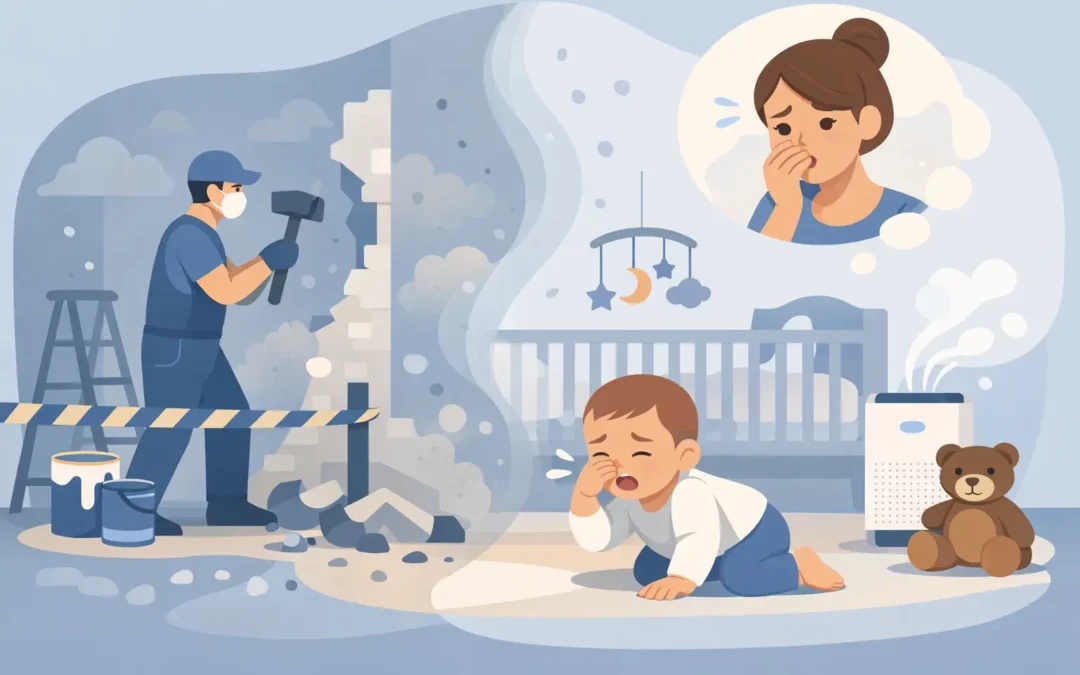
A newly completed nursery can look spotless while fine renovation dust is still settling behind cupboards, inside air-conditioning vents and across window tracks. So, is renovation dust harmful to babies? It can be. Babies breathe faster than adults, spend more time close to the floor and frequently put their hands and toys in their mouths. That makes a dusty, newly renovated HDB flat, condominium or landed home worth preparing carefully before move-in.
The good news is that this is manageable. The aim is not to panic over every speck of dust. It is to remove the fine particles properly, allow the home to air out and deal separately with chemical gases from new materials. A clean-looking home and a genuinely move-in-ready home are not always the same thing.
Why renovation dust can affect babies more
Renovation dust is not one single substance. It can include plaster, cement, wood fibres, paint residue, tile and grout particles, sanding debris, and soil tracked in by workers. The smallest particles are the greater concern because they can remain airborne for longer and travel deeper into the lungs.
For a baby, exposure may lead to temporary irritation of the eyes, nose or throat, coughing, sneezing, a runny nose or unsettled sleep. A baby with eczema, asthma symptoms, allergies or a history of wheezing may be more sensitive. In some cases, the effect is not obvious straight away. Fine dust can settle on cot rails, soft furnishings, milk-preparation surfaces and play mats, then be picked up through normal touching and mouthing.
Construction work involving cutting, drilling or grinding concrete, stone, tiles or engineered surfaces may also create respirable silica dust. This is a particular reason to keep babies, children and pregnant family members away from active renovation areas. The risk depends on the material, the amount of dust created, ventilation and the quality of containment and clean-up.
Older homes undergoing repainting or extensive hacking need extra care. Where old paint or existing finishes may contain harmful contaminants, it is sensible to ask the renovation contractor what materials were removed and how dust was controlled. Do not dry-sweep suspect debris or let children enter until the area has been professionally cleaned.
Is renovation dust harmful to babies after the work is finished?
It depends on how thorough the post-renovation cleaning has been and whether dust is still being disturbed. Once drilling and carpentry have stopped, large visible debris is usually easy to remove. The harder part is the fine powder that slips into the edges of drawers, tracks, skirting boards, light fittings, vents and the backs of built-in cabinets.
A quick vacuum and mop may improve appearances but can miss these hidden deposits. Ordinary domestic vacuums can also release very fine particles back into the room if they are not designed with suitable filtration. Likewise, dry dusting or sweeping can send settled dust into the air again.
Before bringing a baby home, pay close attention to the bedroom, nursery, living area and kitchen. Wipe hard surfaces with damp microfibre cloths, then rinse or replace the cloth regularly rather than spreading dust from one surface to another. Clean from high areas to low areas, finishing with floors. Vacuum upholstered furniture, mattresses and curtains where appropriate, and wash removable fabrics before use.
The air-conditioning system deserves attention too. During renovation, dust can collect around fan coil units and filters. Turning on an uncleaned system may circulate particles throughout the home. Arrange servicing where needed, clean or replace filters according to the unit’s guidance, and keep windows open when outdoor conditions allow while initial cleaning is under way.
Dust is only part of the move-in air-quality question
Parents often use the word “dust” for anything that makes a newly renovated home smell or feel irritating. Yet dust and chemical emissions are different problems and need different solutions.
New carpentry, laminate, adhesives, sealants, paint, vinyl flooring and furniture can release formaldehyde and other volatile organic compounds, often called VOCs. These are gases, not particles, so vacuuming and wiping alone will not remove them. A sharp new-furniture smell, headaches, watery eyes or throat irritation can be a sign that the indoor air needs further attention, although odour alone cannot tell you the level of exposure.
Ventilation helps reduce concentrations, but the result varies with the materials used, the amount of new furnishing, outdoor humidity and how long the home remains closed. In Singapore’s warm, humid climate, many households rely heavily on air-conditioning and keep windows shut for long periods. That can make a sensible pre-move-in plan especially valuable.
For families who want clearer answers, air-quality testing can help identify whether formaldehyde or VOC levels remain a concern after renovation. It is a more useful basis for decisions than simply waiting until the smell seems less noticeable. A baby should not be used as the test of whether the air feels comfortable.
A practical pre-move-in plan for families
Start planning before the renovation team leaves, not on moving day. Ask them to remove construction waste, protect common areas and perform an initial clean. Then allow time for a detailed post-renovation clean before delivery boxes, cot bedding and toys enter the home. Moving belongings in too early gives dust many more places to hide.
For a family preparing a baby’s room, these four checks make the biggest difference:
- Check the hidden surfaces. Open every drawer and cabinet. Run a clean damp cloth along interior shelves, window tracks, the tops of doors, ledges and skirting boards. If it comes away grey or chalky, further cleaning is needed.
- Prepare sleep and play zones last. Keep the cot, mattress, changing mat, soft toys and baby clothes sealed or stored elsewhere until the room has been cleaned, aired and checked.
- Choose controlled cleaning methods. Damp wiping and suitable filtered vacuuming reduce resuspension better than dry sweeping, feather dusters or strong air blasts.
- Separate cleaning from air treatment. Deep cleaning removes deposited renovation residue. Formaldehyde and VOC treatment addresses gaseous pollutants from new materials. One does not replace the other.
If possible, leave a buffer between renovation completion and the baby’s first night in the property. There is no universal number of days because every project is different. A minor repaint and a full flat renovation with extensive built-in carpentry are not comparable. The decision should reflect the amount of work, lingering odours, ventilation, cleaning quality and any air-test findings.
When professional support is the sensible option
Professional post-renovation cleaning is particularly useful after hacking, sanding, extensive carpentry or tile work, or when time is tight before a family move. The value is in the method and coverage: detailed cleaning of cabinets, internal glass, high-touch surfaces, floor edges, tracks and other areas that are easily missed during a rushed handover.
Where new materials are involved, families may also choose a dedicated indoor-air treatment after cleaning. Aura Home Solutions uses non-toxic G-C3N4 neutralisation under its FormaldeX service to target formaldehyde and VOCs at their source, with air-quality testing and warranty protection available for added reassurance. Treatment and cleaning serve different purposes, but coordinating them can remove a great deal of move-in stress.
Seek medical advice promptly if your baby develops persistent coughing, wheezing, breathing difficulty, unusual eye irritation or symptoms that improve when away from the renovated home. For immediate breathing distress, seek urgent medical care. It is also wise to speak with your child’s doctor if your baby has a known respiratory condition and you are planning a major renovation or early move-in.
A calm first night in a new home starts well before the cot is assembled. Give the space time, clean the dust beyond what the eye can see, and make sure the air is ready for the smallest member of the household to breathe comfortably.